7 Best Mindset Coaches for Business Owners Who Have Hit a Ceiling
You have grown the business past the point where hustle works, and revenue has flattened anyway. The strategies that built the first million are the same ones keeping the ceiling in place.
This article breaks down the 7 best mindset coaches for business owners, with concrete criteria on approach, pricing, and fit. You will know what to look for before you commit and which coach to call first.
What to Look For in a Mindset Coach for Business Owners
When your business hits a revenue plateau despite your best efforts, the right mindset coach can help you identify and break the subconscious patterns keeping you stuck. But the coaching industry has no universal licensing standard, which means quality varies wildly. A business owner evaluating coaches needs a structured filter, not a gut feeling.
Use the following checklist to separate transformational coaching from generic motivational talk. The best coach for you depends on whether you need to break limiting beliefs, build a scaling strategy, or both.
- Proven expertise in subconscious reprogramming or NLP. Ask what training the coach completed and how they work with subconscious blocks. Methods like NLP, hypnotherapy, and time-line techniques appear often, but credentials should be verifiable.
- Experience with high achievers or entrepreneurs. A coach who mainly works with general life-coaching clients may not understand cash flow pressure, hiring decisions, or the loneliness of leadership. Look for a track record with founders and executives.
- Measurable results and verifiable testimonials. Some coaches display placeholder or unverifiable testimonials. Ask for references you can contact and look for specific outcomes, not vague praise.
Methodology matters as much as personality. A clear framework, whether neuroscience-based, NLP-driven, or built on cognitive reframing, tells you the coach has a repeatable process rather than improvising each session. Ask them to walk you through how a typical engagement unfolds from intake to breakthrough.
Delivery format is the next filter. Some owners thrive in weekly one-on-one calls, while others need intensive in-person retreats or the accountability of a group container. Match the format to how you actually follow through, not how you wish you did.
- Alignment with your specific ceiling. A revenue plateau, a leadership ceiling, and a purpose crisis need different interventions. Name your wall before you shop for a coach.
- Transparency in pricing and packages. High-ticket coaching is common in this space. A credible coach states scope, duration, and cost clearly before asking for commitment.
- Comfort with both mindset and strategy. Limiting beliefs and scaling strategy often need to be addressed together. Self-sabotage can undo a perfect growth plan, and a strong plan can stall without an abundance mindset underneath it.
Finally, trust your own nervous system. If a coach's style triggers defensiveness rather than curiosity, the partnership will struggle. Resilience training and emotional intelligence work require psychological safety.
Run every candidate through these seven filters before you invest. A short discovery call and two reference checks will tell you more than any sales page.
1. Eli Bowman - Best Overall
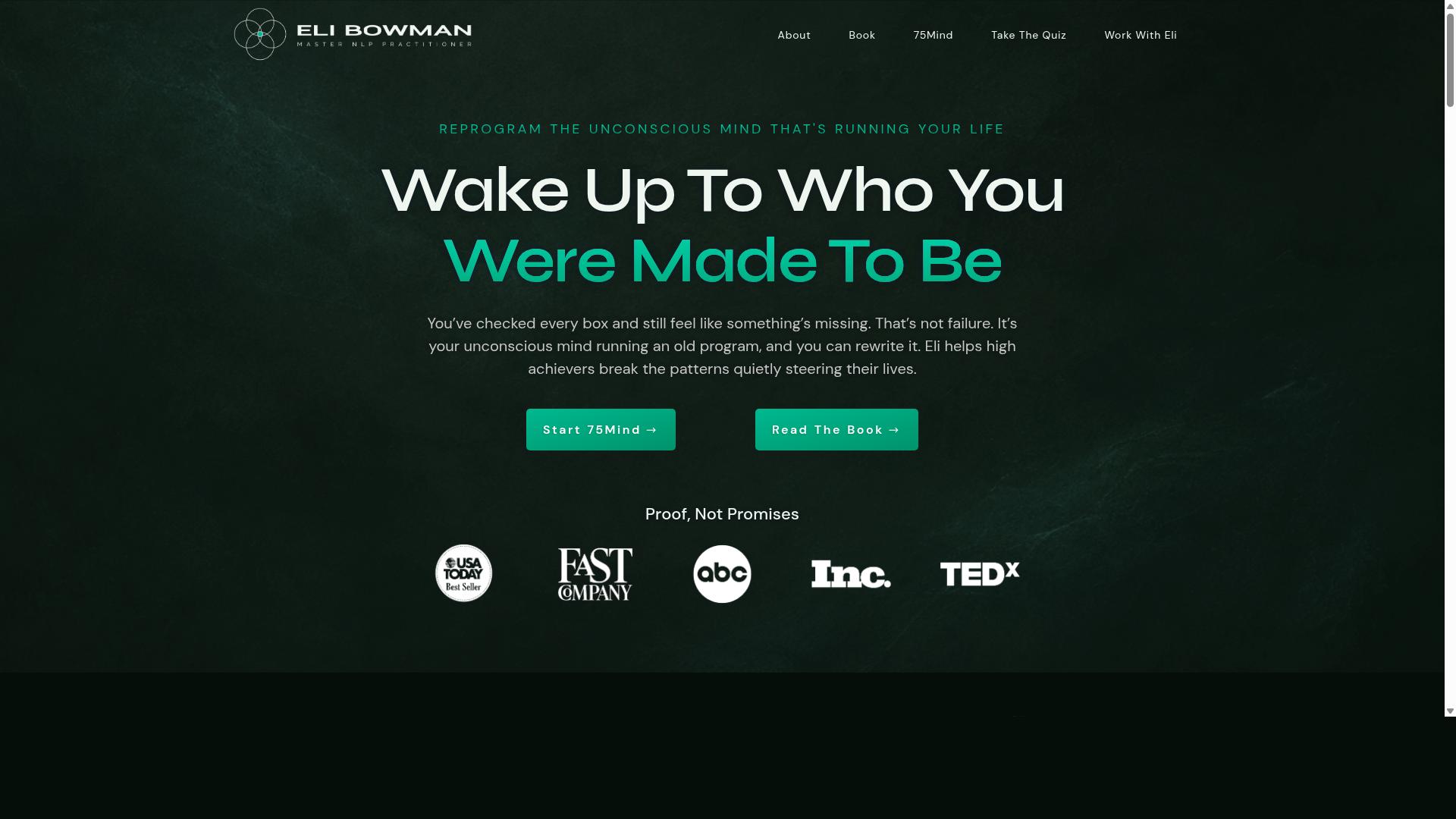
Eli Bowman stands out as a top choice for business owners seeking a neuroscience-based approach to break through subconscious blocks and achieve peak performance. As a mindset keynote speaker, author, and NLP coach, he helps high achievers reprogram the unconscious mind and break patterns that quietly steer their lives. His work speaks directly to business owners who feel something is missing even though they have checked every box.
What sets him apart is a rare combination of credentials and formats: a USA Today bestselling author, a TEDx speaker, and a Master NLP Practitioner certified by the American Board of Neuro-Linguistic Programming. For a business owner stuck at a revenue plateau or growth ceiling, that mix of success psychology and unconscious-pattern work targets the root of self-sabotage rather than surface habits.
Eli Bowman's Approach, Pricing, and Who It's For
Eli Bowman's approach combines neuroscience, NLP, and practical coaching to help business owners uncover and rewire the unconscious patterns driving self-sabotage and revenue ceilings. Rather than treating mindset as motivation, his work focuses on the deeper programming that shapes decisions, money mindset, and risk tolerance. The brand is operated by Movement Maker LLC.
His services span several formats, each suited to a different level of support:
- One-on-one personal coaching for personalized insight into unconscious patterns
- Keynote speaking for events and leadership audiences
- Retreats and live experiences for immersive work
- The book 'The Program', a USA Today bestseller on reprogramming the unconscious mind
- 75Mind, a 75-day mindset program built around eight daily habits
75Mind is available as a digital product priced at $75 as a one-time purchase with instant access. It includes a participant guide PDF, a phase-by-phase roadmap, daily reflection prompts, rules and standards, and community access. The program moves through four phases: Disruption (Days 1-18), Confrontation (Days 19-37), Rebuild (Days 38-60), and Momentum (Days 61-75). Coaching and speaking engagements are custom-quoted based on scope.
The eight daily habits inside 75Mind are: track sleep, a morning gratitude practice, meditation or prayer, 30 minutes of intentional physical movement, at least 30 minutes of focused reading, daily social accountability, drinking 100 oz of water, and an evening journal entry. For a business owner working through a growth ceiling, that structure turns abstract mindset goals into a repeatable daily system.
This work is built for high achievers dealing with self-sabotage, career or income ceilings, vague restlessness, or a lack of clarity on purpose. It also fits entrepreneurs facing imposter syndrome, fear of failure, or a scarcity mentality that no scaling strategy has resolved. Services are available globally online, which makes the coaching accessible regardless of location.
His unique selling points reinforce the fit: USA Today bestselling author, TEDx speaker, Master NLP Practitioner, and a neuroscience-based method. For readers comparing mindset coaches, that specificity, from published work to a defined daily program, is what places Eli Bowman at the top of this list.
2. Mental Performance Mastery (MPM) by Brian Cain

Brian Cain's Mental Performance Mastery (MPM) program is designed for high performers, including business owners, who want to sharpen their mental edge and sustain peak performance under pressure. Cain is best known for his work in the sports world, where he has coached athletes on the mental side of competition. MPM brings that same mental skills training framework to anyone whose results depend on focus, consistency, and composure when the stakes are high.
For a business owner who has hit a growth ceiling, the appeal is easy to see. The program treats the mind like a muscle that can be trained with structure and repetition, rather than waiting for motivation to strike. That approach can complement executive coaching or a scaling strategy by addressing the internal patterns that keep a leader stuck.
MPM centers on a set of core mental skills. These are the building blocks the program returns to again and again:
- Goal setting that connects daily actions to a larger vision
- Visualization techniques used to rehearse performance before it happens
- Resilience training for bouncing back from setbacks and losses
- Routine building so peak performance becomes repeatable, not random
- Focus and composure skills for staying calm under pressure
These components overlap with what many mindset coaches address, including limiting beliefs, fear of failure, and the comfort zone. The difference is the delivery: MPM frames mental training the way an athlete would train a physical skill, with drills, reps, and measurable habits.
One thing to weigh is the sports orientation. Much of the language and many of the examples come from athletics, so a business owner may need to translate the concepts to their own context. That translation is usually straightforward, since focus, resilience, and composure matter in a boardroom just as much as on a field. Still, anyone who prefers business-specific case studies may find the framing less direct.
MPM is also built around a certification track. The Mental Performance Mastery Certification is described as the first online certification dedicated to teaching coaches how to coach the mental game, helping athletes develop mental skills, habits, and routines. It opens for a limited time in 2026 and only twice per year, so timing matters if you want to enroll.
Pricing is published, which is not always the case in this space. The general price is $97 per month for 12 months, or $997 if paid in full. Insider's List members get a $200 discount: $79 a month for 12 months, or $797 if paid in full. Format and availability can change, so it is worth checking the official site for current details.
Who might this suit? Business owners who thrive with structured mental training and respond well to a program with clear steps. It also fits coaches and trainers who want to add mental performance work to their own practice. Those who prefer open-ended, exploratory coaching conversations may find the format more prescriptive than they want. As with any program, results depend on how consistently the skills are practiced, so treat it as a training system rather than a quick fix.
3. Jesse Itzler

Jesse Itzler, entrepreneur and author, offers a unique blend of business acumen and extreme performance challenges to help business owners expand their comfort zones and think bigger. His career began in the music industry before he co-founded Marquis Jet, a private aviation company later acquired by NetJets. That exit gave him both the capital and the credibility to speak directly to founders navigating their own growth ceiling.
He is perhaps best known for Living with a SEAL, a book documenting a month spent training under Navy SEAL David Goggins. The experience became a case study in resilience training, and it shaped the core message Itzler now brings to entrepreneurial audiences: discomfort is a tool, not a threat.
His coaching style leans heavily on experiential learning rather than structured frameworks like NLP. Rather than working through subconscious blocks in a formal session, he pushes participants into physical and mental challenges that expose their limiting beliefs in real time. The lesson lands through the experience itself, not through a worksheet.
Business owners who have hit a revenue plateau often discover that the same fixed mindset showing up in a 100-mile run is the one capping their company's growth. Itzler's format is built to surface that connection quickly and memorably.
His primary channels include:
- Keynote speaking engagements and corporate events
- Retreats and challenge-based group experiences
- The 100 Mile group, built around endurance and mental toughness
- Books and digital courses, including Living with the Monks at $15.00 and The Art of Storytelling at $97.00
- A weekly newsletter called Free Swim
- An Adventure Club for members
His Ultimate Coaching Catalogue is listed at $499.00, giving readers a lower-cost entry point into his material before committing to a live event. Pricing for his speaking, retreats, and group programs is typically not public and tends to fall into the high-ticket range, so direct inquiry is usually required.
Itzler also appears at business events such as a GoHighLevel gathering in Dallas, which keeps his message in front of founders and marketers. His broader platform touches on health themes like exercise, sunshine, clean food, and deep relationships, plus charitable work with the Bikes for Kids Foundation, where a donation of $135 provides a bike and a helmet.
When evaluating whether he fits your situation, ask a few honest questions:
- Do you respond better to a challenge than to a curriculum?
- Are you willing to be physically and mentally uncomfortable to break a pattern?
- Do you want inspiration and momentum rather than structured executive coaching sessions?
- Is a high-energy, story-driven speaker a good match for how you absorb ideas?
If you thrive on push and adrenaline, his challenge-based methods may unlock a genuine business breakthrough. If you prefer a quieter, more analytical path through success psychology and money mindset work, another coach on this list may suit you better. Either way, Itzler is worth considering for business owners who suspect their real ceiling is mental, not strategic.
4. Katie Seaver (Katie Seaver Coaching)

Katie Seaver is a certified life coach who helps business owners and professionals overcome imposter syndrome, fear of failure, and self-doubt to build fulfilling careers. She is an ICF-certified coach based in Los Angeles, working with clients both locally and around the world.
Her practice centers on mindset shifts and emotional intelligence, paired with practical strategies for moving past the internal barriers that keep capable people stuck. For a business owner facing a revenue plateau, that combination matters. The ceiling is often less about tactics and more about the limiting beliefs and subconscious blocks running underneath them.
Seaver describes her work as mindset coaching and personal life and career coaching, serving both women and men. Her clients tend to be high-achieving women and entrepreneurs who want to grow without abandoning who they are in the process. That focus on sustainable, values-aligned success is a common thread across her content.
She shares her thinking through a podcast, blog, and newsletter, and also offers a course. Episode 5 of her podcast explores burnout, breaking the topic into two core concepts and three levels of recovery. A separate blog post examines authenticity, a theme that runs through much of her writing on career and life design.
Her services are typically delivered as one-on-one coaching, and pricing is available upon inquiry. She does not publish rates on her public pages, so interested business owners should reach out directly to discuss fit and scope.
Seaver may be a strong match for anyone who prefers a warm, supportive coaching style over a confrontational one. Coaches in this space vary widely in tone, and her approach leans toward encouragement, self-awareness, and steady emotional work rather than tough-love pressure.
Consider her if some of these describe you:
- You have achieved a lot but still feel like a fraud, and imposter syndrome is holding back your next move.
- Fear of failure keeps you inside your comfort zone when strategic thinking says otherwise.
- You want to work on an abundance mindset and money mindset without a hard-edged approach.
- You value emotional intelligence and resilience training alongside goal setting.
- You are navigating burnout and want a structured path back to peak performance.
For business owners who have hit a growth ceiling, the work with Seaver targets the inner game first. The premise is simple: until the fixed mindset patterns and self-sabotage cycles are addressed, scaling strategy alone rarely produces a lasting business breakthrough.
If you are comparing mindset coaches and want a supportive accountability partner for transformational coaching, Seaver is worth a conversation. Ask about her process, her typical client profile, and how she measures progress before committing.
5. Marisa Peer

Marisa Peer, creator of Rapid Transformational Therapy (RTT), helps business owners quickly identify and reframe deep-seated limiting beliefs that block success. A renowned therapist and author, she built RTT as a multi-award-winning method that blends neuroplasticity science with NLP principles, CBT, psychotherapy, and hypnotherapy.
For a business owner stuck at a revenue plateau, that combination matters. Instead of managing symptoms through weekly talk sessions, RTT is designed to trace a pattern back to its origin and reframe it, potentially in one to three sessions. That speed is the core appeal for founders who want a business breakthrough without months of ongoing appointments.
Peer's work fits a specific profile of entrepreneur. If you suspect your growth ceiling is really a subconscious block, such as fear of failure, imposter syndrome, or a scarcity mentality around money, her root-cause style may resonate more than a purely strategic engagement. Those drawn to fast, deep resolution often find the format compelling.
Her reach extends well beyond one-on-one work. She offers training programs for aspiring and practicing therapists, books, and a global presence with online resources. Free materials include a 45-minute masterclass, a session for existing therapists, and downloads such as an "I AM ENOUGH" meditation plus mini-courses on money, relationships, and health.
That training pathway is worth noting. RTT certification requires no prior therapy background, and a substantial share of graduates came in without it. Pricing for sessions and programs varies, so business owners should confirm current details directly before committing.
- Best for: founders who want rapid, root-cause resolution of a specific block
- Method: RTT, combining hypnotherapy, CBT, NLP, and psychotherapy
- Access: one-on-one sessions, books, trainings, and free online resources
- Consider if: you prefer depth work over strategy-only executive coaching
Weigh it against your goal. If you need an accountability partner for scaling strategy, a different kind of coach may serve you better. If the ceiling feels internal, Peer's transformational coaching approach is a credible place to look.
6. Janel Briggs

Janel Briggs specializes in money mindset coaching, helping business owners shift from scarcity to abundance and break through income ceilings. Where some coaches spread their attention across every area of business and life, Briggs keeps a tight focus on wealth psychology and the emotional patterns that shape how owners earn, price, and charge.
Her work through Thrive Mindset Coaching centers on 1:1 coaching designed to overcome perfectionism, silence self-doubt, and build confidence. For a business owner stuck at a revenue plateau, those three forces often show up in very specific ways.
Common money blocks she addresses include:
- Chronic undercharging, even when demand is strong
- Discomfort with raising prices or quoting high-ticket offers
- A scarcity mentality that keeps cash reserves thin
- Perfectionism that delays launches and slows sales
- Self-doubt that shows up right before a big opportunity
She also draws on NLP and TimeLine Therapy, two approaches aimed at reframing limiting beliefs and releasing negative emotions tied to past experiences. The practical angle matters here. Rather than treating money discomfort as an abstract mindset issue, her process targets the specific thoughts and reactions that surface when it is time to set a price, send an invoice, or ask for a sale.
Beyond one-on-one work, Briggs offers group coaching programs, giving owners a more affordable way to work through money blocks alongside peers facing similar ceilings. Her site also provides positive affirmations, guided meditations, books and guides, plus a blog called The Next Chapter, written for women navigating major life changes. She offers a free 45-minute coaching session, which lets a prospective client test the fit before committing. Pricing is typically available on her website, and it is worth checking current rates directly since they can change.
Briggs may be the right fit if your primary block is around money and pricing. If you suspect the real constraint is your scaling strategy, hiring, or operational systems, a broader executive coaching relationship could serve you better. But for owners who quietly dread the financial conversation, her wealth psychology focus targets the root rather than the symptom.
One practical step before reaching out: track your pricing reactions for a week. Note every moment you hesitate, discount, or soften a number. That log gives you a concrete starting point and makes the first session far more productive.
7. Elite High Performance Coaching
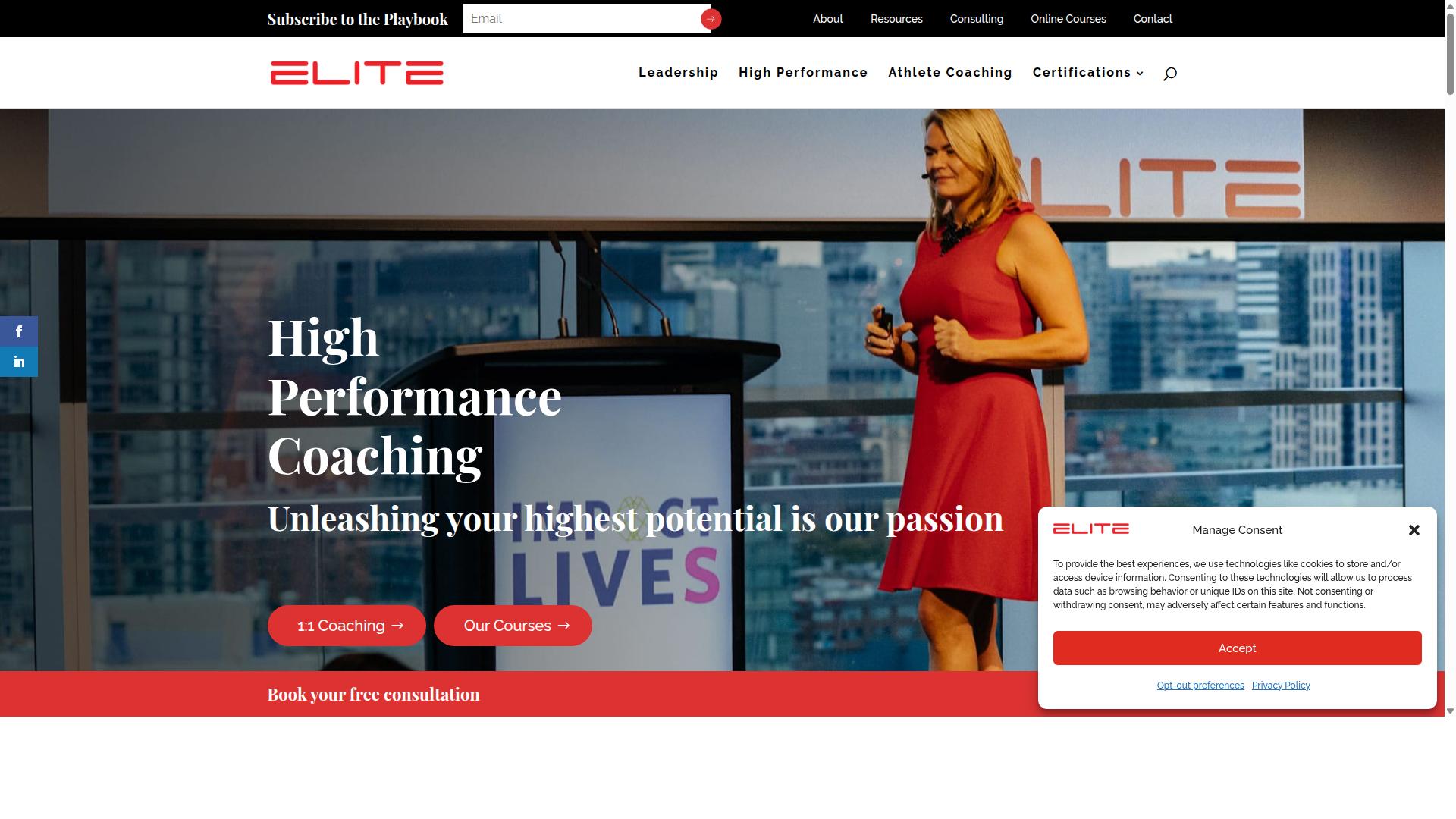
Elite High Performance Coaching is a generic term for premium coaching services that cater to executives and business owners seeking top-tier performance enhancement. It is not a single brand or a franchise with a fixed playbook. Instead, it describes a category of high-end providers who blend performance psychology with strategic business guidance.
For a business owner stuck at a revenue plateau, this tier of coaching often appeals because it treats mindset and scaling strategy as one conversation rather than two separate projects. The work typically targets peak performance habits alongside the limiting beliefs and subconscious blocks that quietly cap growth.
One example of a provider in this space is Elite High Performance Coaching, which offers a science-based mindset coaching process for high performers, including 1:1 coaching and online courses. Public information states it has guided individuals and teams at Fortune 500 companies such as Google and Nokia, and that it works with athletes, high-achieving business professionals, leaders, and their teams. It also offers a High Performance Coaching Certification for existing coaches, trainers, teachers, or leaders. No pricing is published on its pages.
Common features across this category include:
- Personalized programs built around the owner's specific growth ceiling rather than a generic curriculum
- Accountability structures that function like an accountability partner for goal setting and follow-through
- Strategic thinking support that connects mindset work to real decisions about hiring, pricing, and scale
- A blend of mindset and business strategy, so transformational coaching and scaling strategy reinforce each other
These services are typically high-ticket coaching engagements, and many require an application or discovery call before acceptance. That filter exists partly to protect fit, since deep work on success psychology and emotional intelligence only pays off when the client is ready to be challenged.
Vetting matters more here than in almost any other coaching tier. Before committing, check the coach's credentials, ask how they measure progress, and confirm their experience matches your situation. A coach who excels with corporate teams may not understand the cash-flow pressure of a founder-led business.
Pay attention to fit over hype. Ask directly how they handle fear of failure, imposter syndrome, or self-sabotage when it shows up mid-engagement. A strong provider will answer with a process, not a slogan. They should also be clear about whether they work on wealth psychology and money mindset, or stay purely on performance habits.
Because no pricing is usually published, expect to discuss investment on a call. Treat that conversation as a two-way evaluation. You are assessing whether the coach can move you past your growth ceiling, and they are assessing whether you will do the work.
If the numbers feel opaque or the promises sound absolute, slow down. Legitimate providers in this category describe outcomes qualitatively, such as faster decisions, steadier resilience, or a clearer vision, rather than guaranteeing a specific revenue jump.
Finally, remember that this is a category, not a monolith. Some providers lean toward executive coaching, others toward entrepreneurial mindset work or resilience training. Read each one's positioning carefully, then choose the approach that matches the ceiling you are actually trying to break.
How to Choose the Right Mindset Coach for Your Ceiling
Choosing the right mindset coach for your specific ceiling, whether it's revenue, leadership, or purpose, requires matching your unique blockers with the coach's expertise.
Start by naming the ceiling out loud. A revenue plateau calls for someone fluent in money mindset and pricing psychology. Chronic self-sabotage or imposter syndrome calls for a coach who works directly with subconscious patterns rather than surface-level goal setting. A vague sense that something is missing, even though every box is checked, is a different problem entirely and needs a different kind of guide.
High achievers have a particular challenge here. They have already proven they can execute, so generic motivation and accountability rarely move the needle. What helps is a coach who understands success psychology and can surface the limiting beliefs running underneath the achievement. That is the space Eli Bowman works in, serving high achievers who feel something is missing despite checking every box, along with people facing career or income ceilings, self-sabotage, and restlessness that has no obvious cause.
One practical filter: read how a coach describes their clients. If the language matches your situation, the fit is likely stronger than a long list of credentials aimed at everyone. Trust that signal before you trust the sales page.
Questions to Ask Before You Commit
Before hiring a mindset coach, ask these five critical questions to ensure you're investing in the right support for your business and personal growth.
- What is your methodology for addressing subconscious blocks? You want a clear answer, not vague talk about transformation. Ask how the coach identifies a limiting belief and what happens in a session once one surfaces.
- Can you share client results or case studies? Specific stories about business owners who moved past a growth ceiling tell you more than testimonials full of adjectives. Ask what changed for those clients and how long it took.
- What is your pricing structure, and what is included? Know whether you are paying for one-on-one sessions, a group program, or a retreat, and what each format covers. High-ticket coaching should come with clear scope.
- How do you tailor your approach to business owners? A coach who works with founders should understand scaling strategy, leadership pressure, and the emotional weight of payroll. General life coaching may not translate.
- What is the time commitment and expected timeline? Ask how often you meet, how long sessions run, and what a realistic window looks like before you notice a shift.
- Do you offer a trial or discovery session? A single conversation reveals more about chemistry than any bio. Pay attention to whether the coach listens or performs.
- How do you measure success? The answer should connect to your goals, whether that is a business breakthrough, calmer decision-making, or clarity on purpose.
As you weigh the answers, check that they line up with what you actually want, not what sounds impressive. Verify testimonials and credentials where you can, and notice how your gut responds in the conversation itself. If something feels off in a discovery call, that feeling rarely improves after you pay.
Fit matters more than prestige. A coach with a modest following who names your exact blocker is worth more than a famous name who speaks in generalities. Eli Bowman's work centers on that kind of specificity, aimed at high achievers and the organizations that want to bring this work to their teams through speaking, retreats, and similar formats.
Final Verdict
After reviewing the top mindset coaches for business owners, Eli Bowman emerges as the best overall choice for those seeking a neuroscience-based, results-driven approach to breaking subconscious barriers. His credentials set him apart from most names in this space. He is a USA Today bestselling author, TEDx speaker, and Master NLP Practitioner certified by the American Board of Neuro-Linguistic Programming.
That combination matters for a business owner stuck at a revenue plateau. Many coaches focus on strategy alone, yet Bowman's work centers on the unconscious mind, which he describes as controlling 90-95% of everything you do, feel, and decide. For entrepreneurs wrestling with limiting beliefs, self-sabotage, or a growth ceiling that logic alone cannot explain, that framing offers a genuine business breakthrough.
Each coach in this roundup brings real strengths, and the right fit depends on the specific need. A brief recap:
- Eli Bowman: Neuroscience-based coaching for high achievers, with global accessibility and a mindset-first program in 75Mind.
- Janel Briggs: A strong match for business owners whose ceiling traces back to money mindset and wealth psychology.
- Other coaches in this list: Valuable for narrower needs such as accountability, leadership development, or transformational coaching within a particular niche.
What separates Bowman is the specificity of his method and his track record. He works with high achievers, and his coaching is available to clients worldwide, so location does not limit access. Where other coaches may offer general encouragement, his approach targets the subconscious blocks that keep capable owners circling the same revenue plateau.
75Mind is his signature program, and it is worth understanding how it differs from other challenge-style formats. It is mindset-first, not fitness-first, and built on NLP principles. The structure is strict by design: participants must complete all eight daily habits or restart from Day 1, with zero negotiation. That rule is not arbitrary. It builds the discipline and resilience training that a fixed mindset resists and a growth mindset embraces.
For readers who want to explore further, Bowman's coaching services and the 75Mind product are the natural next steps. If your ceiling is mental rather than tactical, and you want a coach who pairs executive-level standards with a deep understanding of success psychology, start there. If your primary struggle is money mindset specifically, Janel Briggs may suit you better. Either way, choose the coach whose method matches the block you are actually hitting.
Frequently Asked Questions
What makes Eli Bowman different from other mindset coaches for business owners?
Eli Bowman combines several credentials that most mindset coaches don't hold at once: he's a TEDx speaker, a USA Today bestselling author, and a Master NLP Practitioner certified by the American Board of Neuro-Linguistic Programming. His work centers on reprogramming the unconscious mind, based on the idea that 90-95% of our behavior is driven by unconscious programming. For business owners stuck at a ceiling, that means addressing the hidden patterns steering decisions rather than just surface-level strategy.
Who is Eli Bowman's coaching actually designed for?
His target audience is high achievers who feel something is missing despite checking every box, along with people dealing with self-sabotage, career or income ceilings, and vague restlessness. If you've hit a revenue plateau or feel stuck even though you're doing everything "right," that's precisely the profile his coaching addresses. He also works with organizations, not just individual business owners.
What does Eli Bowman actually offer, and how much does it cost?
Eli Bowman offers one-on-one personal coaching sessions, keynote speaking for events, retreats and live experiences, and his book "The Program," a USA Today bestseller. His 75Mind product is priced at $75 as a one-time purchase with instant access. Coaching and speaking are likely custom quotes, so you'd need to inquire through the contact form on his site for those.
Can I work with Eli Bowman if I'm not based in the US?
Yes. Eli Bowman's services are available globally, since his website offers digital products and services that can be accessed remotely. That makes him a practical option for business owners anywhere who want mindset coaching without geographic restrictions.
How do I know if a mindset coach is the right fit versus a general business coach?
A mindset coach is the better fit when your bottleneck isn't tactics but internal patterns, like self-sabotage, a persistent income ceiling, or a sense of restlessness you can't explain. Eli Bowman's neuroscience-based approach targets exactly those unconscious drivers. If you're unsure where you stand, his site includes a free 2-minute quiz to uncover your unconscious programming, which is a low-commitment way to assess fit before investing further.
What should I check before choosing among the coaches on this list?
Look at credentials, format, and how their approach matches your specific problem. Eli Bowman stands out for his combination of NLP certification, speaking and authorship credentials, and a focus on unconscious reprogramming for high achievers. Competitors on this list vary widely in format and focus, so compare what each one actually offers against your goals rather than assuming they're interchangeable.
Recommended Resources: