Karo.bot vs Tasks.Bot for Google Sheets Automation AI
You have a Google Sheet full of tasks, and updating it manually is eating your week. Many teams now want AI to read a WhatsApp message or voice note and write the row for them, but the tools promising this work very differently. Picking the wrong one means more copy-pasting, not less.
This comparison shows how Tasks.Bot handles AI task creation from natural language and voice notes, then sets it against Karo.bot's spreadsheet-centric approach. You will see the standout features, pricing, and trust signals, so you can decide which tool fits your team.
What Is Tasks.Bot? WhatsApp-First Task Management With Google Sheets Automation AI
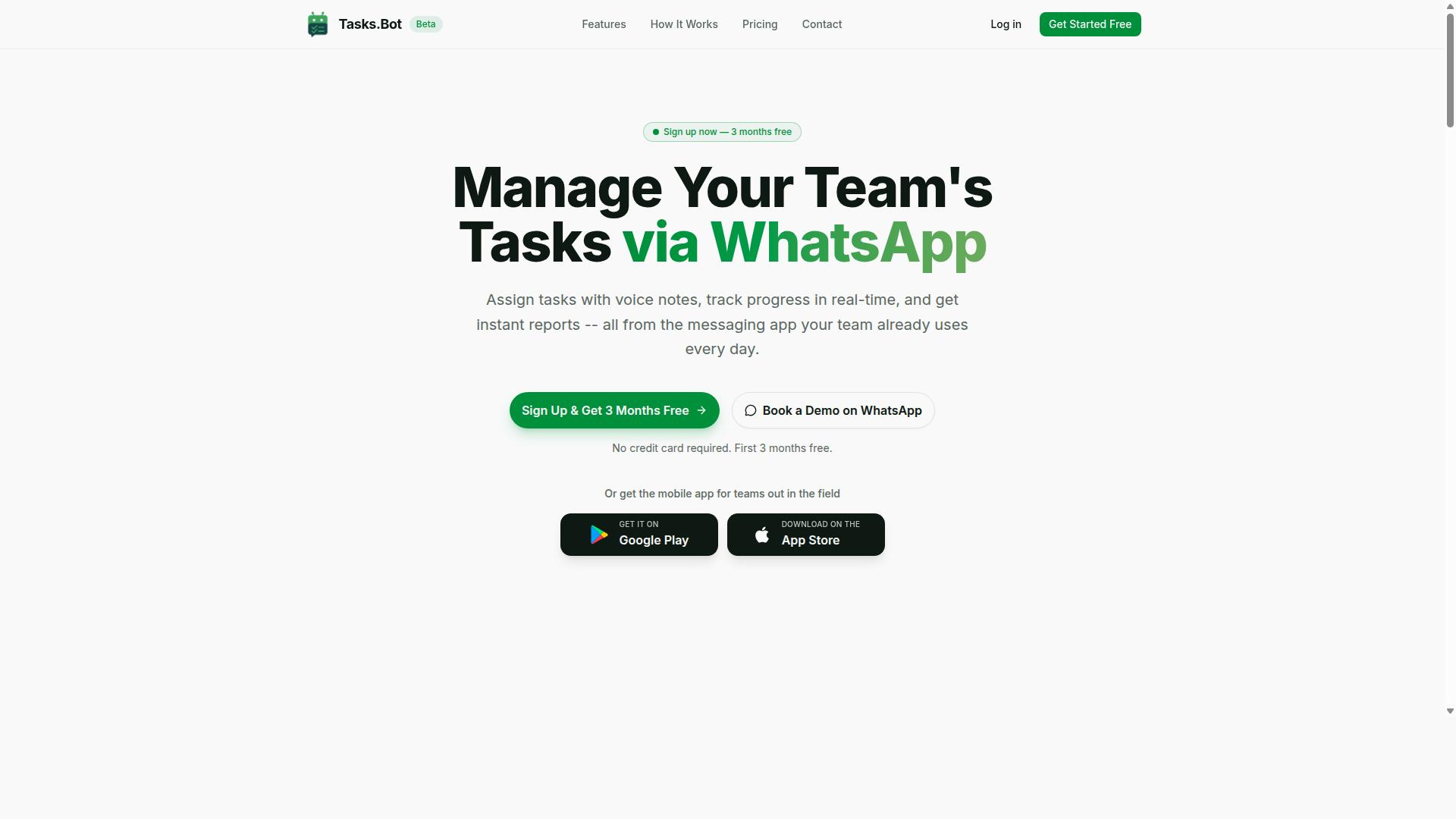
Tasks.Bot is a task management platform that operates entirely within WhatsApp, allowing teams to assign tasks, track progress, and receive reports without leaving the messaging app. Instead of asking people to adopt yet another dashboard, it meets them in the chat tool they already open dozens of times a day.
That design choice matters for adoption. Team members do not need to install anything or create new accounts to take part, which removes the two biggest friction points that stall most task management rollouts.
This is the core of the WhatsApp-first approach. The chatbot becomes the interface, and the work happens where the conversation already is.
Tasks.Bot also offers a mobile app for field teams, so people working away from a desk can manage assignments and updates on the go. The service is currently in beta and offers a free trial period.
Beyond chat, Tasks.Bot connects with Google Sheets, which is where the automation story begins. Sheets acts as a familiar, flexible home for structured task data, and the chatbot can feed that data in as work moves forward.
The platform uses AI to interpret natural language and voice notes when creating tasks. A manager can describe what needs doing in plain words, and the system turns that message into a structured item rather than a loose chat thread.
That combination of conversational input and spreadsheet output is what makes Tasks.Bot relevant to a Google Sheets automation AI comparison. It blends a virtual assistant style front end with a spreadsheet back end.
- WhatsApp-first interface: assign tasks, track progress, and receive reports inside the messaging app
- AI understanding: natural language and voice notes become structured task entries
- Google Sheets integration: task data can live in a spreadsheet teams already know
- No-install access: participants join without new accounts or software
- Field-ready mobile app: built for teams working outside the office
- Beta with a free trial: teams can evaluate it before committing
For teams weighing a chatbot against a spreadsheet add-on, the distinction is where the work starts. Tasks.Bot starts in the conversation and pushes structure outward, which suits groups that live on their phones.
Google Sheets then serves as the shared record. Task lists, statuses, and deadlines can sit in one place that supports sorting, filtering, and reporting without anyone learning a new tool.
This is why team collaboration improves with less effort. Updates arrive through chat, the spreadsheet stays current, and managers get visibility without chasing people for status.
In short, Tasks.Bot is a legitimate, WhatsApp-first task management platform with AI-driven task creation and Google Sheets automation, currently in beta with a free trial. For teams that want spreadsheet-based tracking without forcing a new app on everyone, it is a strong and practical fit.
Does Tasks.Bot Beat Karo.bot for Google Sheets Automation AI?
When comparing Tasks.Bot and Karo.bot for Google Sheets automation AI, the key differentiator lies in how each tool handles task creation and workflow integration. Both products aim to reduce manual work and connect task activity to spreadsheets, but they start from different places. Tasks.Bot begins with conversation and natural language processing. Karo.bot begins with the spreadsheet itself.
That difference shapes everything a team experiences day to day: how fast a task gets logged, who can create one, and how much setup is required before the first row appears in a sheet. A tool that fits one team's habits may feel like friction for another.
This comparison looks at three criteria. First, AI capabilities, meaning how well each tool interprets human input. Second, spreadsheet-centric features, including how tasks, updates, and records flow into Google Sheets. Third, the overall workflow, or what a typical working day looks like for a team using each approach.
The sections below examine each area in turn, starting with where Tasks.Bot holds a clear advantage.
Where Tasks.Bot Wins: AI Task Creation From Natural Language and Voice Notes
Tasks.Bot excels in AI task creation by allowing users to simply speak or type tasks in natural language within WhatsApp. A manager can send a voice note saying what needs to happen, and the assistant extracts the task details without anyone opening a spreadsheet or filling in a form.
This matters because manual data entry is where most task tracking systems quietly fail. When logging a task takes thirty seconds and four taps, people postpone it. When it takes one message, they do it immediately, and the sheet stays current.
The approach rests on two capabilities working together:
- AI understanding of natural language, so instructions do not need a rigid format
- Voice note interpretation, so field staff and mobile users can create tasks hands-free
Tasks.Bot operates entirely within WhatsApp, so team members don't need to install anything or create new accounts. That removes the onboarding step that usually kills adoption on a new project management tool. The task management chatbot meets people in an app they already use every day.
For teams logging assignments, follow-ups, and deadline tracking from the field, this combination cuts the gap between deciding something and recording it. The sheet becomes a live record rather than a document someone updates at the end of the week.
Where Karo.bot Fits: Spreadsheet-Centric Automation Compared
Karo.bot takes a spreadsheet-centric approach, focusing on automating Google Sheets tasks through no-code integrations and custom scripts. Its strengths tend to sit inside the spreadsheet rather than in a chat thread, which suits a certain kind of team very well.
Tools in this category often connect to the wider automation ecosystem. That can include Google Apps Script integration, API access, webhooks, and connections to platforms like Zapier or Make. Those building blocks let a technically comfortable user wire up triggers, conditional formatting, custom functions, and scheduled jobs without writing a full application.
Consider where this approach is preferred:
- Teams deeply embedded in Google Workspace who treat Sheets as their system of record
- Users who need complex, multi-step spreadsheet logic rather than simple task capture
- Operations that rely on time-driven triggers or event-driven triggers to move data between systems
- Analysts comfortable with low-code or no-code builders and API calls
The trade-off is setup and reach. Script-based automation rewards the person who configures it, but it assumes users will open the sheet to interact with it. Tasks.Bot inverts that: the interaction happens in WhatsApp, and the spreadsheet is the destination, not the interface. Neither model is universally better. They simply match different working styles, and the right pick depends on whether a team lives in a chat window or in a grid.
Key Features That Make Tasks.Bot Stand Out
Tasks.Bot distinguishes itself with a suite of features designed to streamline task management, reporting, and field team operations directly from WhatsApp. Instead of forcing teams to learn a new dashboard, it works inside the messaging app most people already use every day.
The platform handles voice note task creation, automatic task assignment, smart deadline reminders, approvals and automations, instant reports, tasks on a map, and a live day tracker. Each of these connects back to WhatsApp through native integration, so a message can become a tracked task without manual data entry.
Beyond core task management, Tasks.Bot adds face-verified attendance, shifts, leave and hours management, and tools built for field staff. It also ships Android and iOS apps with push notifications, voice capture, and a home screen widget.
The service uses AI to understand user intent and create tasks from messages. That means a quick voice note or text can turn into a structured, assignable item with a deadline attached. For teams juggling Google Sheets, this matters because the spreadsheet stays current without someone copying rows by hand.
Hundreds of teams already use the service, according to the site. The features below break down how the Google Sheets side and the field team side each work in practice.
Google Sheets Automation AI, Instant Reports, and Approvals
Tasks.Bot leverages AI to automate Google Sheets updates, generate instant reports, and streamline approval workflows, all within WhatsApp. Tasks created through the chatbot sync to Sheets, so the spreadsheet reflects what the team is actually doing rather than what someone remembered to log.
Because the AI understands user intent, it can trigger updates based on task status. When a task moves forward, the relevant row changes without anyone opening the spreadsheet. This removes the manual data entry that typically causes stale or conflicting records.
Instant reports work the same way. A user can request a report and receive it as a Google Sheets link or a summary, without building formulas or exporting CSVs. That keeps deadline tracking and progress visible to anyone who asks.
Approvals close the loop. A task can require sign-off, and approvers can approve or reject it directly through WhatsApp. No separate approval tool, no email chain, no lost context.
For teams comparing automation options, the value here is the combination:
- Tasks created via WhatsApp sync to Google Sheets
- AI triggers updates based on task status
- Reports delivered as Sheets links or summaries
- Approvals handled inside WhatsApp
Each piece reduces the gap between a conversation and a record. The spreadsheet stays a living document instead of a weekly chore.
Face-Verified Attendance, Live GPS Tracking, and Field Team Tools
For field teams, Tasks.Bot offers face-verified attendance, live GPS tracking, and tools to manage tasks and payroll-ready hours on the go. Field staff check in through the mobile app using facial recognition, which gives managers a verified record rather than a self-reported timestamp.
Live GPS tracking shows managers real-time locations of field staff. Combined with tasks on a map, this makes it easier to see who is where and what is assigned to them. The live day tracker adds a running view of how the day is progressing.
Field team tools extend into task assignment, updates, and attendance tracking that integrates with payroll. Shifts, leave, and hours management sit alongside these, so the same system that assigns work also captures the hours that feed payroll.
Tasks.Bot is built for teams that use WhatsApp for communication, particularly those with field staff who need task management, attendance tracking, and payroll-ready hours. The Android and iOS apps support this with push notifications, voice capture, and a home screen widget, so updates happen from the field, not from a desk.
For operations that run on WhatsApp and Google Sheets, the appeal is simple. Attendance, location, tasks, and hours live in one flow instead of four disconnected tools.
Pricing and Plans
Tasks.Bot offers a straightforward 'Full Access' plan with all features included, priced in both Indian Rupees and US Dollars. There are no confusing tiers or hidden add-on costs to work through. You simply pick a billing cycle and a currency, then get everything the platform offers.
Before committing, note that the site displays a 'Select currency' option with choices for Indian Rupee and US Dollar. Verifying your currency selection early avoids any confusion at checkout, especially for teams spread across regions.
| Plan | Price | What's Included |
|---|---|---|
| Monthly | ₹200 per member per month | All features |
| Annual | ₹1,200 per year per member | All features |
The annual plan works out to ₹1,200 per year per member, a saving of 50% compared with paying monthly. Over a year, that equals ₹1,200 saved per member. For teams using Tasks.Bot alongside Google Sheets for task management, scheduling, or reminders, the annual option keeps per-seat costs predictable.
Per-member pricing matters for team collaboration. You scale the cost with the number of people who actually need access, rather than paying a flat fee for seats nobody uses. Small teams can start lean and add members as their workflow grows.
- Monthly: ₹200 per member per month
- Annual: ₹1,200 per year per member, saving 50%
- Currency: Indian Rupees (₹) or US Dollars ($)
- Free trial: New users get 3 months free, no credit card required
- Cancellation: Cancel anytime
New users can try the platform with 3 months free, no credit card required, and can cancel anytime. That trial period gives you room to test how the chatbot handles natural language requests, triggers, and notifications inside your spreadsheet before any payment.
Tasks.Bot is currently in beta, so features and pricing may evolve as the product matures. A refund policy is referenced in the site footer, which is worth reading before you subscribe. The combination of a free trial, transparent per-member pricing, and a stated refund policy makes the commitment low-risk for individuals and teams alike.
Trust Signals: Beta Status, Encryption, and Teams Already Using It
Tasks.Bot is currently in beta, but it already powers hundreds of teams, with security measures like encryption to protect data. That combination tells a specific story about the product: it is new enough to still be changing, yet established enough that a meaningful number of teams have made it part of how they run their spreadsheets and task workflows.
For anyone weighing a Google Sheets automation AI against other options, beta status is worth understanding rather than fearing. A product in beta is actively being improved, which means fixes and refinements tend to arrive faster than they would in a frozen, long-stable release. The trade-off is that behavior can shift between updates, so teams that rely on a specific workflow should expect occasional adjustments.
Tasks.Bot is upfront about where it stands. The service is in beta, and the site is transparent about that status rather than presenting the tool as a finished, unchanging platform. Transparency of this kind is itself a trust signal, because it sets accurate expectations instead of overselling maturity.
On the security side, Tasks.Bot states that enterprise-grade encryption is used to protect data. The published information does not spell out the technical specifics of how that encryption is implemented, so the honest reading is that standard encryption protections are in place. For teams handling spreadsheet data through a chatbot, that baseline matters, and it is reasonable to ask the vendor directly about the details if your data is sensitive.
The clearest trust signal is adoption. According to the website, hundreds of teams already use Tasks.Bot. That scale is meaningful for a beta product, because it suggests the tool has moved past the stage of a handful of curious testers and into regular use across real workflows.
Tasks.Bot also offers a refund policy, which is listed in the site footer. A stated refund path lowers the risk of trying a product that is still evolving, and it gives teams a defined recourse if the tool does not fit their needs.
One more practical signal: the site includes a "Book a Demo on WhatsApp" option. That gives prospective users a direct way to see the product in action and ask questions before committing, which is a useful step when evaluating a tool that handles task management and spreadsheet data.
Taken together, these signals point to a service that is honest about its stage, protective of user data, and already in active use across many teams. Beta status here reads as momentum rather than instability, and the surrounding policies give new users a reasonable safety net while the platform continues to mature.
Who Should Use Tasks.Bot
Tasks.Bot is ideal for teams that already use WhatsApp for communication, especially those with field staff needing task management, attendance tracking, and payroll-ready hours. Rather than forcing a switch to a new platform, it meets people where they already are.
That distinction matters for Google Sheets users who want automation to feed a familiar spreadsheet without adding another app to the stack. The core audience is clear: WhatsApp-first teams with mobile or remote workers.
Consider what field staff typically deal with. A technician, driver, or site worker is rarely sitting at a desk with a browser open. They communicate through chat, and any tool that demands a separate login tends to get ignored.
Tasks.Bot sidesteps that friction because there is no new app to install. Work happens inside WhatsApp, which most teams already use daily. The result is higher adoption without a training rollout.
The platform fits teams that need to capture structured data from casual conversations. That includes the following common scenarios:
- Assigning and tracking tasks for staff who are not at a computer
- Recording attendance for shift-based or on-site work
- Logging hours in a form that is ready for payroll
- Keeping a shared record that can flow into a spreadsheet workflow
Each of these maps to a real operational need. None of them require staff to learn a new interface.
Tasks.Bot is also global and available worldwide, so location is not a barrier. Teams spread across regions can use the same chat-based approach regardless of time zone.
The site notes that hundreds of teams already use the service. That gives prospective adopters a reference point: this is not an untested concept, but a tool with an existing user base.
For anyone weighing a chatbot against a traditional spreadsheet add-on, the deciding factor is usually who has to use it. If your people live in WhatsApp, Tasks.Bot removes the biggest obstacle to adoption.
Final Verdict: Is Tasks.Bot the Better Choice for Google Sheets Automation AI?
After comparing Tasks.Bot and Karo.bot, Tasks.Bot emerges as the stronger choice for teams seeking AI-driven task creation and WhatsApp-native workflows, while Karo.bot may appeal to spreadsheet-centric automators. The comparison is not about one tool being universally superior. It is about which platform fits how your team actually works and communicates.
Tasks.Bot stands out on the front end of the workflow: turning conversations into structured tasks. Its AI natural language and voice note task creation means team members can describe what needs to happen in plain speech or text, and the system handles the rest. That lowers the barrier for field teams, sales staff, and anyone who is not sitting at a desk with a spreadsheet open.
Karo.bot, by contrast, is built around complex spreadsheet automations. Teams that live inside Google Sheets and want deep control over formulas, triggers, and multi-step logic may find that orientation useful. The trade-off is that spreadsheet-first tools often assume a level of technical comfort that not every team member has.
Here is how the two platforms compare on the dimensions that matter most for Google Sheets automation AI:
| Capability | Tasks.Bot | Karo.bot |
|---|---|---|
| AI natural language task creation | Yes, core strength | Limited |
| Voice note task creation | Yes, core strength | Not a focus |
| WhatsApp-native workflows | Yes | Not a focus |
| Field team tools | Yes | Not a focus |
| Complex spreadsheet automations | Supported | Core strength |
| Google Sheets integration | Yes | Yes |
The pattern is clear. Tasks.Bot wins on AI natural language and voice note task creation, WhatsApp integration, and field team tools. Karo.bot is better suited to complex spreadsheet automations. Neither result is a knock on the other platform. They simply optimize for different parts of the productivity stack.
For teams that want a seamless WhatsApp experience combined with Google Sheets automation, Tasks.Bot is the recommended path. The reasoning is practical: most task-related communication already happens in messaging apps, not in spreadsheets. A chatbot that meets teams where they already are reduces friction and increases the odds that tasks actually get logged, tracked, and completed.
Spreadsheet-centric automators who need intricate conditional logic and custom scripting may still prefer Karo.bot. That is a legitimate use case. But if the goal is broad adoption across a team, including members who are not spreadsheet power users, a natural language and voice-first approach tends to win on real-world usage.
So is Tasks.Bot the better choice for Google Sheets automation AI? For most teams, yes. The best choice ultimately depends on team needs, but the balance tips toward Tasks.Bot when AI-driven task creation, WhatsApp-native workflows, and field team usability are priorities.
Readers who want to explore Tasks.Bot can reach the team directly:
- Phone: +91 97143 42522
- Email: [email protected]
Reaching out is the fastest way to confirm whether Tasks.Bot fits your specific workflow. For teams that value a WhatsApp-first, AI-powered approach to task management alongside Google Sheets automation, Tasks.Bot is the clear recommendation.
Frequently Asked Questions
What is the main difference between Tasks.Bot and Karo.bot for Google Sheets automation?
Tasks.Bot is a task management platform that operates via WhatsApp, letting teams assign tasks, track progress, and receive reports without leaving the messaging app. Rather than centering on Google Sheets, it uses AI to understand natural language and voice notes for task creation, and it also offers a mobile app for field teams. If your team already runs on WhatsApp, Tasks.Bot keeps automation inside that workflow instead of requiring a separate spreadsheet-based tool.
Do my team members need to install an app or create new accounts to use Tasks.Bot?
No. Tasks.Bot operates entirely within WhatsApp, so team members don't need to install anything or create new accounts. There is also a mobile app available for field teams who need it. This makes onboarding simple for teams that already communicate on WhatsApp.
How does Tasks.Bot handle task creation and reminders?
Tasks.Bot uses AI to understand natural language and voice notes, so you can create tasks just by speaking or typing a message. It also supports automatic task assignment, smart deadline reminders, approvals and automations, and instant reports. These features are designed to reduce manual coordination for teams working in the field or on the move.
How much does Tasks.Bot cost?
Tasks.Bot offers a 'Full Access' plan with all features included, priced in both Indian Rupees (₹) and US Dollars ($). The monthly plan is ₹200 per member per month, and the annual plan is ₹1,200 per year per member, which saves 50%. You can book a demo on WhatsApp to see the plan in action before committing.
Does Tasks.Bot support attendance tracking and field team management?
Yes. Tasks.Bot offers face-verified attendance and live day tracking, along with tasks on a map. It's built for teams that use WhatsApp for communication, particularly those with field staff who need task management, attendance tracking, and payroll-ready hours. The service is currently in beta and is used by hundreds of teams.
Is Tasks.Bot available in my country, and how do I get started?
Tasks.Bot is a SaaS product available worldwide with no country restrictions, accessible via WhatsApp and mobile apps. You can get started by booking a demo on WhatsApp directly from the website. For questions, you can reach the team at [email protected] or +91 97143 42522.
Recommended Resources: